
Why Do Maldivians Fear the Police Instead of Feeling Protected?
For a modern democratic society, public trust is not optional—it is the foundation upon which effective policing is built.
For most citizens around the world, the sight of a police officer brings a sense of security, reassurance, and protection.
Whether in a busy city street in the United Kingdom, a neighborhood in Japan, or a town in Australia, police officers are generally viewed as guardians of public safety. Their presence often makes people feel safer.
In the Maldives, however, many citizens express a very different sentiment. Rather than feeling reassured, a significant number of people report feeling uncomfortable, nervous, or even fearful when encountering police officers on the streets. This growing perception raises an important question: Are the fundamental principles of policing in the Maldives being applied correctly?
A Relationship Built on Fear Rather Than Trust
One of the most common concerns raised by members of the public relates to the manner in which police officers interact with ordinary citizens.
Many people complain that when they are stopped on the road, they are often approached with suspicion rather than respect. The tone of questioning can sometimes be harsh, creating the impression that the individual is already considered guilty of wrongdoing.
In many democratic nations, modern policing is built upon the principle that every person is innocent until proven guilty. Police officers are trained to approach citizens professionally, politely, and respectfully. Even when conducting routine checks, officers in countries such as Japan, Canada, and the United Kingdom generally introduce themselves, explain the reason for the stop, and maintain a courteous attitude.

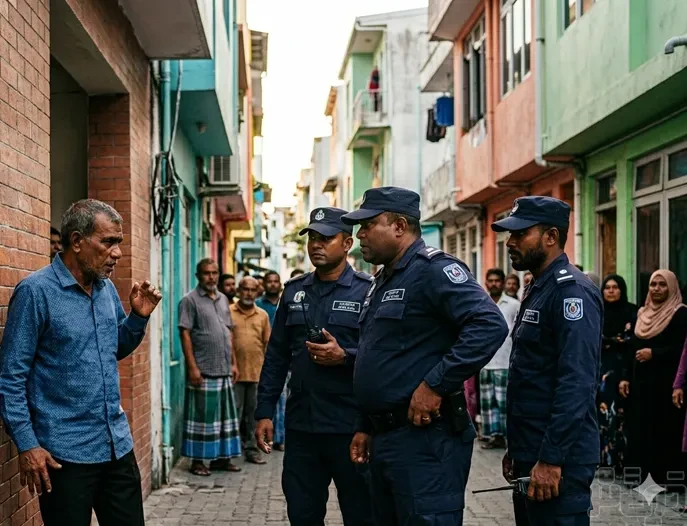
a fictional image of pleasant police interaction with public
The objective is simple: to gain cooperation through public trust rather than through intimidation.
Many Maldivians believe that this principle is often missing from everyday policing practices in the country.
Why Do Criminals Appear Less Concerned Than Ordinary Citizens?
Another criticism frequently heard among the public is the perception that genuine criminals often operate openly without fear, while law-abiding citizens are more likely to be stopped and questioned.
Gang members and repeat offenders are often well known within communities. Yet many citizens feel that these individuals move freely and confidently, while ordinary people are subjected to frequent checks and questioning.
Whether this perception is entirely accurate or not, the fact that it exists is itself a concern. Public confidence in policing depends not only on actual results but also on visible fairness.
When citizens believe that enforcement efforts disproportionately affect innocent people while criminals continue their activities unchecked, trust in law enforcement inevitably suffers. Effective policing requires officers to focus intelligence, resources, and operational efforts on genuine criminal threats rather than creating unnecessary discomfort among law-abiding members of society.
Has the Police Service Lost Focus?
A broader concern relates to the role and priorities of the Maldives Police Service. Under the Constitution and national laws, the primary responsibilities of the police include maintaining law and order, preventing crime, investigating offences, enforcing traffic regulations, and protecting the rights and freedoms of citizens.
However, many observers argue that police resources increasingly appear to be directed towards functions that are traditionally associated with other institutions.
The Maldives Police Service is frequently involved in search and rescue missions, maritime operations, emergency response activities, and firefighting support. While these services undoubtedly benefit the nation and demonstrate dedication by police personnel, critics argue that such responsibilities may divert attention and resources from core policing functions.
Traffic enforcement remains a significant challenge. Investigations often face delays. Public complaints regarding criminal activities sometimes take considerable time to resolve. At the same time, concerns regarding gang violence, drug-related offences, and youth crime continue to persist.
Many citizens question whether the police service is attempting to perform too many functions at once, potentially weakening its effectiveness in its primary mission of crime prevention and law enforcement.
Lessons from Successful Policing Models
Some of the world’s most respected police services share common characteristics. In Japan, community policing places officers directly within neighborhoods where they build relationships with residents and solve local problems before they escalate.
In the United Kingdom, the principle of “policing by consent” emphasizes that police legitimacy comes from public trust rather than authority alone. In Singapore, strict law enforcement is balanced with professionalism, accountability, and efficient service delivery.
In all of these systems, public trust is considered a strategic asset. Police effectiveness is measured not only by arrests and prosecutions but also by the confidence citizens have in those tasked with protecting them.
The Need for Reform
Reforming policing does not mean criticizing individual officers who work long hours under difficult circumstances. Many police officers serve professionally and with genuine commitment to public safety.
However, institutions must continuously evolve to meet public expectations.
Several reforms could help strengthen public confidence:
- Greater emphasis on communication skills and respectful public engagement.
- Enhanced community policing programs that build relationships with local residents.
- Increased focus on targeting repeat offenders, gangs, and organized criminal networks.
- Clearer separation of responsibilities between law enforcement agencies and other emergency services.
- Stronger accountability and oversight mechanisms.
- Faster and more transparent criminal investigations.
- Improved training focused on human rights, public service, and professional conduct.
A Police Service the Public Can Trust
The ultimate purpose of policing is not merely to enforce laws. It is to create an environment where citizens feel safe, protected, and respected.
A successful police service is one that causes criminals to fear the consequences of breaking the law while allowing ordinary citizens to go about their daily lives with confidence and peace of mind.
As discussions about national security and law enforcement continue in the Maldives, the central question remains: Should citizens feel fear when they see a police officer, or should they feel protected?
The answer to that question may determine the future direction of policing reform in the Maldives.
For a modern democratic society, public trust is not optional—it is the foundation upon which effective policing is built.