E-Voting in the Maldives: A Promise of Modern Democracy or a Risk to the People's Voice?
An analytical deep dive into the risks, political vulnerabilities, and technological hurdles of implementing e-voting systems in the Maldivian archipelago.
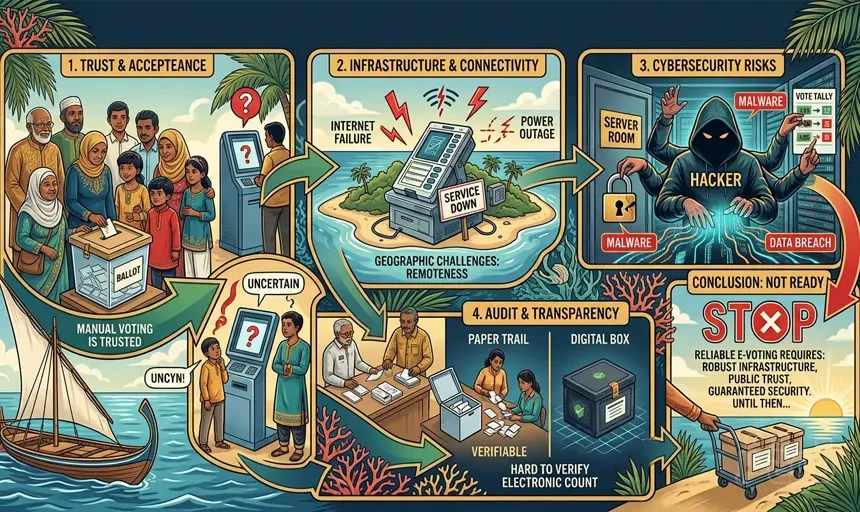
The allure of e-voting is often sold as a panacea for the logistical nightmares of a geographically fragmented nation like the Maldives.
Democracy depends on a simple but powerful principle: every eligible citizen should have a fair opportunity to choose their representatives, and every vote should be counted accurately.
With nearly 200 inhabited islands scattered across the Indian Ocean, the physical transport of ballot boxes is an arduous, expensive, and time-consuming endeavor.
However, the push for electronic voting systems (EVS) in the Maldives carries profound risks that go far beyond mere logistical convenience. As the nation weighs the implementation of digital ballots, it must confront the reality that for a fragile democracy, the convenience of a click may come at the cost of the integrity of the vote.
The Mirage of Efficiency
Proponents of e-voting argue that it eliminates the human error inherent in manual counting and accelerates the delivery of results. In the Maldives, where election results have historically been flashpoints for national tension and civil unrest, the speed of digital tabulation is marketed as a stabilizer. Yet, this efficiency is a double-edged sword.
When results are generated in milliseconds by proprietary software, the transparency of the process vanishes. The average citizen cannot audit the code behind a digital ballot, creating a 'black box' election where voters must blindly trust the Electoral Commission and the private vendors supplying the hardware.
The Shadow of Global Failure
The Maldives does not need to look far to see the dangers of digital electoral systems. Globally, countries that have experimented with e-voting have often retreated due to catastrophic failures. In the Netherlands, the discovery that machines could be hacked from several meters away led to a total ban on electronic machines in 2008. Similarly, Germany’s Federal Constitutional Court ruled in 2009 that e-voting was unconstitutional because the process could not be understood by the public without specialized knowledge.
When a system is too complex to be verified by a layperson, it violates the fundamental democratic principle that elections must be public and verifiable. If the Maldives adopts such technology, it risks inviting similar vulnerabilities, potentially allowing sophisticated state or non-state actors to manipulate outcomes through backdoors or malware; especially in this era where public has little or no trust in the administration, for its accumulation of democratic powers; both legislative and judicial and for its alleged dishonesty.
Political Dangers and Manipulation
The political landscape of the Maldives is characterized by intense partisanship and a history of allegations regarding foreign interference. Introducing an electronic layer to this environment provides a new, lucrative target for manipulation. Unlike a physical ballot, which requires physical access to thousands of dispersed locations to rig, an electronic system could theoretically be compromised from a single remote location.
Furthermore, statistics suggest that cyber-attacks on critical infrastructure have risen by over 300% in the last decade globally. If the Maldivian electoral server is breached, the entire national mandate could be rewritten in minutes. Additionally, the lack of a paper trail or the reliance on a digital-only audit makes it nearly impossible to conduct a meaningful recount if the results are contested.
The Vulnerability of Decentralization
While the Maldives is physically decentralized, its power structures are highly centralized. An e-voting system would likely be managed by a central authority, creating a single point of failure.
If the central server suffers from a technical glitch, a power outage, or a deliberate denial-of-service (DoS) attack, or more importantly a deliberate manipulation of data effectuates, the entire election could be paralyzed.
- Data Integrity: The risk of bit-flipping, unauthorized or reticent data alteration.
- Anonymity: Digital systems often struggle to maintain the perfect balance between verifying a voter’s identity and ensuring their vote remains private.
- Vendor Lock-in: The reliance on international tech firms creates a dependency that compromises national sovereignty.
Key statistics from the 2023 presidential election
Indicator Round 1 Round 2 Eligible voters 282,395 285,631 Voters who participated 225,486 246,915 Voter turnout 79.85% 87.31% Valid votes 220,651 239,027 Invalid votes 4,835 7,888 Ballot boxes reported by the Elections Commission 574 586 These figures suggest that we already have the capacity to organise elections that attract considerable public participation. They also mean that reform should focus on identifiable shortcomings rather than assume that the existing system has failed simply because it is not fully digital.
A Critical Path Forward
The implementation of e-voting in the Maldives should not be viewed as an inevitability of progress. It is a choice with massive consequences for the nation's political health. Before any digital system is introduced, the government must ensure that the process is transparent/open-source, allowing independent cybersecurity experts to audit the code.
Moreover, the maintenance of a voter-verified paper audit trail (VVPAT) is non-negotiable. Without a physical paper record that the voter can inspect before casting their digital vote, there is no way to verify that the software performed as expected.
Ultimately, it shall be decided (by means of a Public Referendum) if the speed of digital results is worth the sacrifice of public trust. The history of democratic consolidation suggests that transparency is the most important ingredient in an election. If the public cannot see the process, they will not believe the result.
The political dangers: When technology becomes a tool of power
Cybersecurity is only one part of the debate. A voting system can be technically sophisticated and still undermine democracy if it gives powerful actors excessive control over the process or prevents citizens from challenging the result.
For the Maldives, the most serious question is not whether a computer can count votes. It is whether the institutions responsible for the computer can be trusted, scrutinised, and held accountable.
Consider these risks prior to considering any such major reform.
Manipulation on a national scale
Traditional ballot-based elections can be affected by misconduct, including ballot tampering, intimidation, improper counting, and interference with election administration. Electronic systems do not automatically eliminate these risks. Instead, they can introduce different ways of interfering with an election.
Consider a hypothetical system in which votes are recorded electronically and aggregated by a central platform. If a serious vulnerability allows an unauthorised person to alter election records, the resulting problem might affect multiple constituencies. The danger becomes greater if the electronic records are the only authoritative evidence of how citizens voted.
In that situation, election officials might be unable to reconstruct the original result independently.
This does not mean electronic manipulation is inevitable. It means the consequences of a successful attack could be substantial.
A system should be designed on the assumption that somebody may eventually attempt to compromise it.
Independent audits, paper records, strict access controls, and transparent procedures can help limit the damage.
The risk of insider interference
Not every threat comes from an external hacker.
Some of the most sensitive risks involve people who already have legitimate access to election systems.
These could include system administrators, contractors, software developers, or officials responsible for configuring and operating equipment.
An insider might misuse access privileges, bypass established procedures, conceal an error, or make an unauthorised change. This is why no single individual or organisation should control every critical stage of an electronic election. A sound governance framework should require:
- Separation of duties.
- Multiple-person authorisation for sensitive actions.
- Tamper-evident logs.
- Independent review of software and configuration changes.
- Secure management of cryptographic keys.
- Publicly documented procedures.
- Legal penalties for deliberate interference.
- Independent investigation of credible complaints.
The goal is to make misconduct difficult to carry out, easier to detect, and possible to investigate using evidence that the suspected person cannot simply erase.
The threat to ballot secrecy
The secret ballot protects citizens from retaliation, pressure, and coercion. A voter should be able to support a candidate without fearing punishment from an employer, political organisation, family member, or public official. Remote internet voting makes this protection particularly difficult.
At a supervised polling station, election officials can establish procedures intended to protect the secrecy of each ballot. At home, however, a voter may be asked to show a completed ballot to another person, vote while being watched, or prove that they supported a particular candidate.
A malicious application or compromised device could also expose a voter's selections. Even a system that keeps the central election database secure cannot necessarily prevent someone in the voter's physical surroundings from applying pressure. For this reason, ballot secrecy is not merely an encryption problem. It is also a question of social conditions and the practical ability to vote freely.
A remote voting system must be assessed against the possibility of coercion, not just against the possibility of hacking.

Political pressure and the independence of election authorities
An election authority must be able to administer elections impartially and explain its decisions publicly. Electronic voting can make that responsibility more complicated. If only a small group of technical specialists understands how the system works, political parties and citizens may have difficulty evaluating claims about its accuracy.
Suppose an election result is challenged. The election authority announces that the system has been tested and that the software produced the correct result.
But what if independent observers cannot inspect the relevant evidence? What if the source code is confidential? What if the system's operator is also responsible for investigating allegations against it?
Even if the original result is correct, the lack of independent verification can undermine confidence. This is why election technology requires strong institutional safeguards. No government, political party, contractor, or election official should be able to demand that the public accept a digital result merely because an authorised person says it is correct.
The credibility of an election depends on the public's ability to examine the evidence—not simply on the authority of the institution announcing the result.
Disinformation and the manipulation of public confidence
A cyberattack does not have to change a single vote to cause political damage. An attacker may attempt to create uncertainty about the election, publish misleading screenshots, circulate fabricated technical reports, or falsely claim that the results have been altered.
The objective may be to persuade citizens that the electoral process cannot be trusted. The National Academies has warned that efforts to undermine confidence in election results can themselves threaten democratic institutions. Electronic voting could make such attacks more consequential if the public has little independent evidence with which to assess competing claims. At the same time, governments and political parties must not exploit cybersecurity concerns to dismiss legitimate criticism.
An allegation should neither be accepted automatically nor rejected merely because it is politically inconvenient. Credible claims require evidence, independent investigation, and public explanation.
The best defence against election disinformation is a system in which citizens can see how results were produced and how disputes were resolved.
Foreign interference and national sovereignty
Digital election systems can create dependencies that extend beyond national borders. Foreign suppliers may develop or maintain software. Cloud providers may host services. External contractors may supply security updates or manage technical infrastructure.
These arrangements can be legitimate, but they must be evaluated carefully. The risks include unauthorised access, supply-chain compromise, disruption of essential services, and dependence on organisations operating under other jurisdictions.
A country does not necessarily lose control of an election because it purchases foreign technology. However, it may weaken its practical independence if it cannot inspect, operate, audit, or recover the system without outside assistance.
The Maldives should therefore require a clear account of where sensitive election data is processed, who can access it, and how operational independence will be maintained. National sovereignty in digital elections means more than hosting a website inside the country. It means retaining effective control over the systems and evidence needed to conduct and verify an election.
The danger of accepting technology without public consent
A government may argue that electronic voting is necessary because it is efficient, modern, or widely used in other countries. Those arguments are not sufficient on their own.
Voting is a fundamental democratic process. Changes to how votes are cast and counted should be introduced through transparent public consultation, clear legal authority, and independent technical assessment. Citizens should be able to ask questions about the proposed system and receive answers that do not require advanced computer knowledge.
Political parties should be given a meaningful opportunity to review the safeguards. Civil society groups, journalists, disability advocates, and cybersecurity researchers should be able to participate in the debate.
The public does not need to understand every line of software. It does, however, need a reasonable way to establish that the election can be independently checked.
Introducing a system without sufficient public explanation risks turning a potentially useful reform into a source of political division.
The danger of a false sense of security
One of the most persuasive arguments for e-voting is that modern technology can be encrypted, tested, and protected by multiple layers of security. These safeguards are important, but they do not make a system invulnerable. Encryption can protect information while it travels between systems. It cannot guarantee that the original vote was entered correctly on a compromised device. Digital signatures can help establish whether a message has been altered. They cannot independently prove that the software interpreted the voter's intention correctly.
Blockchain technology can preserve a record of transactions. It cannot, by itself, prove that the original vote was authentic, that the ballot was secret, or that a compromised device recorded the voter's intended choice.
Security depends on the entire process. The most dangerous assumption is that because a system uses sophisticated technology, its results must be correct. No voting system should be exempt from independent scrutiny simply because its designers describe it as secure.
In an era where misinformation, manipulation, political greed and corruption is rampant, an e-voting system that cannot be understood or audited by the average citizen is a recipe for skepticism, protest, and instability. The archipelago’s path to a more efficient democracy should be paved with robust cybersecurity, public education, and a steadfast commitment to the physical verification of the popular will, rather than an uncritical embrace of digital tools that have failed elsewhere.